Thoughts on American citizenship

I just got an email from my company’s Global Migration team about U.S. Naturalization Workshops they’re hosting. I laughed for a bit and then smiled at the fact that this is relevant in the company and then that something like this would be offered for free. It would be a 30 minute session, 1:1 with a naturalization attorney to discuss the family situation, and the process (there’s a LOT of process).

Then I realized that this actually applies to me too. For those who don’t already know, even though I’ve lived a total of 18 years (out of my 24) in the United States, I’m still technically a citizen of the Republic of Korea. Sure, I’ve been a visa holder, and now bear a Permanent Residency, but in some ways there’s always been some sort of invisible barrier, or mark that subtlely reminded me that I was still an outsider. Growing up, this wasn’t something that really seemed to matter, other than being a mental note and a BIG inconvenience when applying for colleges, jobs, etc. When I first came back to the U.S. in 2000, I as a J-2 dependent, under my dad’s J-1. J-visas, I believe, are for foreign contract workers, without the intent to immigrate; in other words, not allowed to apply for permanent residency. At some point, I shifted to R-2 under my mom, and had it until moving to PR status. Yes, what an honor; I am now a resident alien of this country, and have my fingerprints in some database in the Department of Homeland Security. Yay.

Not surprisingly, I’ve always felt that my relationship to the U.S. government and the country itself was a bit conditional; despite growing up taught that my story is one of many millions, and virtually every person with an immigrant story in their family history (yes white people, you fall into this category too–gasp), yet something seems to happen to those people bearing the U.S. Citizen title, and enjoy privilages not available to the millions of other non-citizens living in this land.

Let me say in advance, that I don’t quite use the terms “American” and “U.S. citizen” interchangably. I know U.S. citizens that haven’t spent more than a few weeks of their adult lives in this country, and certainly don’t relate to the culture, as well as non-citizens that are working for the political campaigns, pay dues to the NRA, and have kids in American public schools. Who’s the more “American” one of those two?

Most people don’t really think about citizenship this way–they’re either born into one country or the other, and they don’t bother doing anything else. If they choose to stay in the United States, they’re generally happy about it enough, and their citizenship status to care. Even activist Americans that seem to treat the term as if holding a little bit of shame don’t deny that they’re Americans. For most people, it’s really simple–it’s something associated with the country you happen to live in; it’s something you’re born with, and no more changable than the culture you live and breathe. Having spent 2/3rds of my life in this country (and probably 90% of my formative years), and yet still not being a citizen, I’ve always thought of the concept very archaic, and with regards to the process of changing citizenship, it’s filled with rules that I never really bought into logically. As a teacher, what do you teach a kid that’s learning about Thanksgiving in school, if there are non-citizens in the room? Do you call them out to recognize that they’re different, or that this history doesn’t apply to them, or teach that there isn’t anything different, and that many cultures come together to make this country? My second grade teacher (Mrs. Halversen, Willard Elementary; Evanston, IL–if you ever see this, you’re awesome!) chose the latter, and it seemed to make sense; for natural-born and naturalized Americans, as well as foreigners and hybrids like me.

Well that’s great when you’re growing up, or in college, grad school, med school. You’re paying money (or your parents are in the form of taxes) to get an education, and people will generally assume that you’re a contributing member of society. Growing up, many of my friends were in a simlar boat, and that made it very easy to discuss the challenges, and work through the ambiguous. Besides, our pride for Naperville North, the Fighting Illini, and Chicago was far more feverent than this abstract concept of national pride. Much of that changes if you choose to work, and take those skills/knowledge that you gained while in school to make money in the great U, S of A, like I’ve chosen to do. Sure much of the multi-culturalism is there, but now that taxes, elections, and societal impact are concerned, it seems to matter so much more what color your passport is. I believe I’m contributing to the larger world, but I’ve definitely been privilaged to have grown up, and to work and live where I do.

Do I consider myself American? Haha, that’s a tough question. Historically, I’ve said no, and understood that my status made me somewhat different. Do I consider myself Asian-American? Absolutely. The feelings, privilages, and difficulties as well as my story fits very closely. Is citizenship tied to it? It probably should, more than it does, but I feel my experience would have been the same even if I had been born as a citizen. If my parents I had moved to Chicago a year earlier, I would have been a natural-born American, and we wouldn’t be having this conversation. As for citizenthip, despite the fact that it should be the ultimate representation of your heart’s loyalty to a culture, usually, the reasons why someone is one or the other is completely arbitrary, and influenced far more by practical reasons than one’s loyalty to the words of Francis Scott Key.

And you know what… I think I’m okay with that. Kind of like software patents, it’s an archaic system that’s broken in so many ways, that it might as well be scrapped. But it provides some value, and in a noisy world where we need to label and generalize to live and make sense of things, it helps a great deal. It’s not a problem that many have to even think about, my parents certainly didn’t, and my kids probably won’t–but as a very small segment of the story, I feel a need to write about my experience. I’ll do that some day. In the mean time, I’ll check out this workshop =).

Thanks Global Migration team!

Facebook/Twitter Connect, Disqus brings blogs together

In the last few years, there were leaps forward in web services world that changed how we think of digital identity and how it comes to be used in the blogging world; the former occurred when the idea of delegated authentication came to fruition via OAuth, Facebook Connect, Windows Live ID DelAuth, and others; and the latter happened via Disqus.

Previously, online communities were like closed silos of people and content; each member could post on a family of pages that the service provider operated, be it Blogger, Xanga, Live Journal, or Facebook. You logged into a site, and you got to use that identity within the site. This worked if your community of readers and writers were all affiliated with the same site, but the general web trends at the time were of users being on multiple sites, having multiple identities. For the blogging community, this posed a challenge, especially if you were hosted your own blog; each user had to register in order to give them a personalized experience. It was difficult to track comments from anonymous users, and verifying identity was very difficult. It was a world of anonymous cowards and spammers.

Things changed in late-2008 when Facebook released Facebook Connect and the opening of their developer APIs. Facebook Connect allowed your identity on Facebook to be used (in a secure fashion) outside of Facebook, and allowed external applications to get Facebook data for use. While the principles of Facebook Connect had been around since  2006 under a more generic term (delegated authentication), Facebook was unique since it had nearly global membership (upwards of 90% in most U.S. colleges).

Facebook represented a new wave of online services where people began to care about “Real ID”. Whereas most digital identity in the past had relied on aliases (who remembers who CrouchingTigr45 was?), Facebook emphasized real names, and real connections. This had two implications; first, the user was much more attached to their identity (changing an alias = easy; changing your name = hard); second, the identity was no longer was mentally constrained to the site (you use your name outside of Facebook, don’t you?). With Facebook Connect, this meant that nearly everyone on the web (that mattered) had a way to carry their identity across unrelated services, as long as the service trusted the Facebook identity. Then along came Disqus.

Disqus

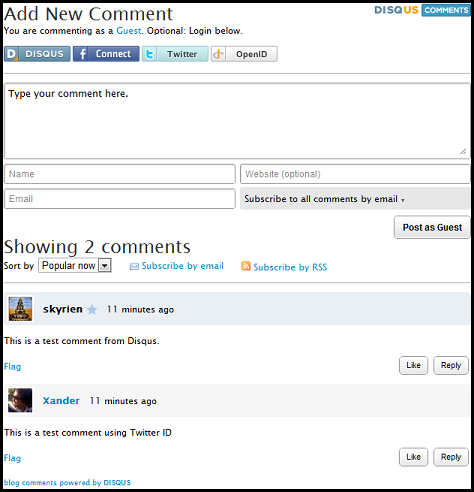
Disqus,  is an outsourced commenting system that can rely on either it’s own identity, or a connected identity from Facebook, Twitter, or Open ID. Instead of hosting the comments directly within WordPress, you can install a Disqus plugin on your self-hosted blog, and suddenly the singular blog is entitled to all the features of a massive web community. Bloggers benefited since it allowed individuals to participate immediately in the discussion, upping the community’s activity, and also provided services at scale that individuals may have had difficulty managing on their own. For users, it let users seamlessly use an ID that they already knew how to use.

Advances such as this don’t come all too often in the web services world; but every few years, it can greatly change how we interact with the social web.

This post was originally published by Skyrien on the Taco Bell on Ogden community blog.

Thoughts on black-asian race relations coming from A Good Day to be Black and Sexy (2008)

A film by Dennis Dortch; A between-the-sheets peek at Black Love and Sexuality.

I had a chance to watch A Good Day to be Black and Sexy (2008) earlier today; let me definitely say “Thank you Netflix!” If it wasn’t for you, I would never have the fortune to find completely random stuff like this that I would come to enjoy. I’ll admit, before I watched the film, I was expecting something along the likes of Soul Plane, a ‘unique’ (if not utterly ridiculous) film, exemplifying (and exploiting) the over-the-top hip-hop archetypes of material worship and what some would call misogyny. In stark contrast, Black and Sexy is a delicate film depicting six related vignettes to show an interesting cross section of indiviuals and relationships in different states of stress as they go about defining moments. I particularly enjoyed Tonight (Part II), and American Boyfriend, both of which I thought showed rarely depicted yet universally understood relationship interactions. The latter, which I’ll speak on here, deals with the only interracial couple throughout the film, with Jesse (Alphonso Johnson) being the illicit black boyfriend of Jasmine (Emily Liu), who is a second generation Chinese-American.

Contrary to many films dealing with an asian character in a supporting role, especially one in an “African-American romance” film, I felt that Jesse and Jasmine’s interactions, particularly the interracial quirks of a black-asian couple, surprisingly authentic. It’s beauty lies in the subtleties of the acting, and both performers play it well off each other (if not with each other). While the scene in the first half is ridden with mildly race-related undertones, it is done under the pretext of flirtatious banter and is certainly not an unnatural concept.

The interesting bit comes in the second half when her first-generation parents come home, and Jesse is hidden in Jasmine’s room. After failing to sneak Jesse out, she ends up going downstairs for dinner, leaving Jesse upstairs in her room to call a friend to discuss what he perceived as the ridiculousness of the situation. Meanwhile, Jasmine downstairs is confronted by her parents about her affair, and while she attempts to dodge most questions, finally concedes when asked “is he Chinese or American?” If it wasn’t understood already, Jasmine’s mother asks if he is a blue-eyed blond, making it clear that by “American”, Jasmine’s parents are clearly referring to “white”. Almost as if it was a cop-out, she says “American”, which is technically, if not semantically, true. While progressive minded second generation asians may cringe at the exploration of this theme, it is likely an experience that every asian raised in North America can relate to. “It” being the ever-present, either subtly or overly, racist undertones against those of African descent, ironic given the near universal recognition of Michael Jordan and Tiger Woods among sports-watching native asians.

So how did this come to be? It’s hard to say, given that at the turn of the last century, there was just as much dislike of those of European ancestry. Perhaps it had to do with the various military incidents of Okinawa, the tales of the Rodney King riots in LA, the transported stereotypes from their native lands as multi-culturalism takes root, or, perhaps more interestingly, transmuted stereotypes from American culture finding interpretation among Asia. Regardless, racism of various forms directed at blacks are a reality among many first and zero generation asian immigrants. Now, I’d like to make a clear distinction between racism of first and second (and beyond) generations. The vast majority of second generation asians know full well the history of race relations in America, and are more prone to play racist among decidedly American stereotypes, though, I’d have to say, at a less overt level than that among white or black Americans (when is the last time you saw a group of asian people yelling racist slurs at a passerby? Probably a lot longer, though the reasons are debatable).

In any case, the struggle that Jesse and Jasmine are facing will be distinctly familiar to those of either decent, and I remember actually watching American Boyfriend in great suspense as I wondered how this conflict would flare up. As Jasmine is becoming more at ease with her “American boyfriend” story, Jesse becomes increasingly agitated as the minutes wear by. He finally snaps, he starts dribbling his basketball in an overt rejection of his covert status, and Jasmine becomes increasingly flustered attempting to divert the discussion somewhere else. Finally, he marches downstairs in an overt disruptive show, stomps around the dinner table and makes a point to kiss Jasmine right in front of her shocked mother, before storming out with a grin.

I really enjoyed this scene for what it depicted, a smack in the face at traditional-minded racist views of an oppressor. Yes, part of me wasn’t entirely happy with Jesse’s rejection of the subtleties of asian-black race relations, but I’ll admit, he was right to. Much to the direector’s credit, the depiction of the stress in Jasmine and her family felt authentic, and the righteous exit of Jesse was well justified. It did make me wonder though, about why race relations between blacks and asians are so tense and undefined in an allegedly “post-racial” society.

Now, I’m not saying that there aren’t other sources of tension and mutual struggles for legitimacy in a society that is still very white-centric, but I need to ask: what factors contribute to the particular asian-black interaction? In particular, what is different that characterizes asian-black interaction versus asian-white or black-white race relations in America?