Xander’s College Life: Year 4
Chapter 2: Imagination Lost
So I’ve been wondering lately: Why am I not daydreaming anymore? Many years ago, when I’d be bored with something I was doing, or otherwise unoccupied in my thoughts, I’d let my mind wander off into more fantastical thoughts; some worth writing down and fleshing out in greater detail, others simply transient thoughts that entertained me while I thought them. Imagination was my powerful tool, a means of escape from the boring or mundane aspects of my life. Even a few years ago, when I’d be waiting for a bus, or driving up to Chicago… or you know, something where you’re physically doing something but mentally unchallenged, I’d be thinking of some new story, or some new concept that I would want to explore.
These days, I’m doing no less thinking; but instead of exploring the imaginative depths of my mind, I’m finding myself trolling the factual internet (like wikipedia, ars technica, wired, and such), thanks to insanely comprehensive linking, jumping from page to page endlessly. Just yesterday, I started reading about Halo , went to read about Ringworld , then the Kardashev Scale , then onto the Manifold Series , before settling into the philosophical realm of teleology … and before I knew it, a couple of hours had gone by; and this could happen on almost a daily basis.
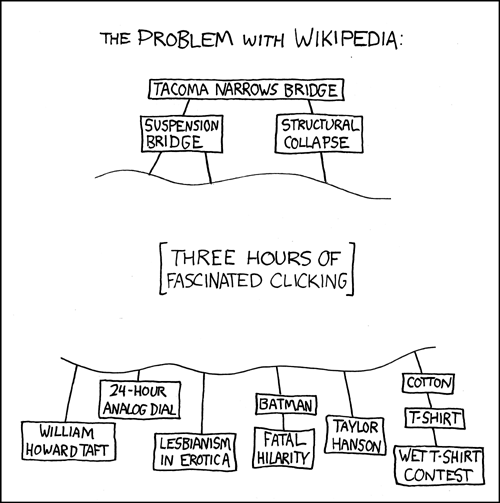
All of this is great; I’m expanding my breadth of knowledge base, but then I realized that I’m not going into any sort of depth at all. These are all quick fixes of information; like factual drugs. Even worse, I’m not developing my own thoughts and ideas like I used to years ago.
Pseudo-productivity
Big things, whether they’re papers or projects are always the hardest at the beginning, where frequently, I find myself putting off the big important things (things that I need to spend considerable time at) in favor of little bits of things, like traversing the Wikiverse, that really have no end, and thus no final accomplishment. It’s an odd form of procrastination, that leaves me feeling *almost* like I spent it being productive, but in the end though, I’ve just blown away several hours, and realized that there is still much more to learn, and that whatever thing I had been putting off is that much closer to being due.
Now, for some actionable items: One, I need to read more. I haven’t finished reading a book in almost 6 months, and I don’t even remember what the last one was. Maybe it’s even more than that. Two, I need to get stuff done as soon as I decide to do them. I still have to send stuff to the UK, and it’s been like… 3 months since I said I would. I still need to help an old friend get some business taken care of, and it’s been 6 months! Among other things, big and small. Three… I need to spend more time in things that I can invest in, and less in those temporarily amusing, but ultimately transient pleasures. Third… I need to stop sleeping at 5 AM when I have class at 9.
Then… hopefully, I’ll get my imagination back.
That is all.
