Category: life

NYC

There’s something very magical about the largest cities of the world; whether it’s in Asia, Europe, or North America, every time I’m in one, I’m inspired by the energy of the citizens, enthusiasm of travelers, to a point where I’m completely content just to walk the streets and watch people go about their day. I’ve felt this in Seoul, Beijing, Shanghai, Paris, Los Angeles, San Francisco, Chicago, and now finally, New York City.

Of course, out of all of these, New York is probably the only place in North America that can compare with the other “major” cities of the world in terms of sheer size and pace. The entire downtown of Seattle could probably fit in one East/West strip of midtown Manhattan, and it was incredible seeing endless rows of skyscrapers knowing that there are just as many rows behind them. From the Avenue of the Americas, to the Canyon of Heroes, to Broadway, New York doesn’t disappoint when it comes to showing you how big Manhattan life can be.

IMG_0693

NYC also had the unique feeling of being the Mecca for all things that matter in the mainstream America. San Francisco has it’s tech niche, Seattle has music and art (and some tech), but get to New York and make it big; that is, success in America. Whether it’s in finance, performance, international politics, tech success, culinary mastery, fashion, entertainment, get recognized in New York and it’s the world giving it’s cheers. I’ve got to hand it to New York for being one of the world’s living, beating centers of human existence. I wonder if I would perceive it’s glory if I had grown up there, but for an outsider, taking my first real taste of the city, it’s truly something else, and a place that everyone must see.

That said, in the midst of all things grand, it was still the little, human things that got to me most; The hardworking street vendors closing up their shops; the crazy hobos spreading their the world-is-coming-to-an-end FUD; NYC subway crews smiling (or not) at people passing by, and so on. Instead of being a statistic in a city of nearly eight million souls (something that many from smaller towns seem to fear), each seemed to be raised up by the combined energy of the city.

The most awesome thing is, despite having spent nearly 5 days in New York, it feels like I’ve hardly even scratched the paint; there’s so much I haven’t done there that I know that I’ll have to be back. A month, or maybe even a year. I haven’t seen the nitty gritty yet that I know is out there, perhaps just off on another block, and I wonder if I’ll eventually be disillusioned by what I perceive now to be grandeur, but I’m pretty thick-skinned, and my passions die hard.

And once again, I come back to my life routine, having witnessed something awesome, and inspired by something grand–work is a little more meaningful here, and I’ve been reminded about why I love to travel.

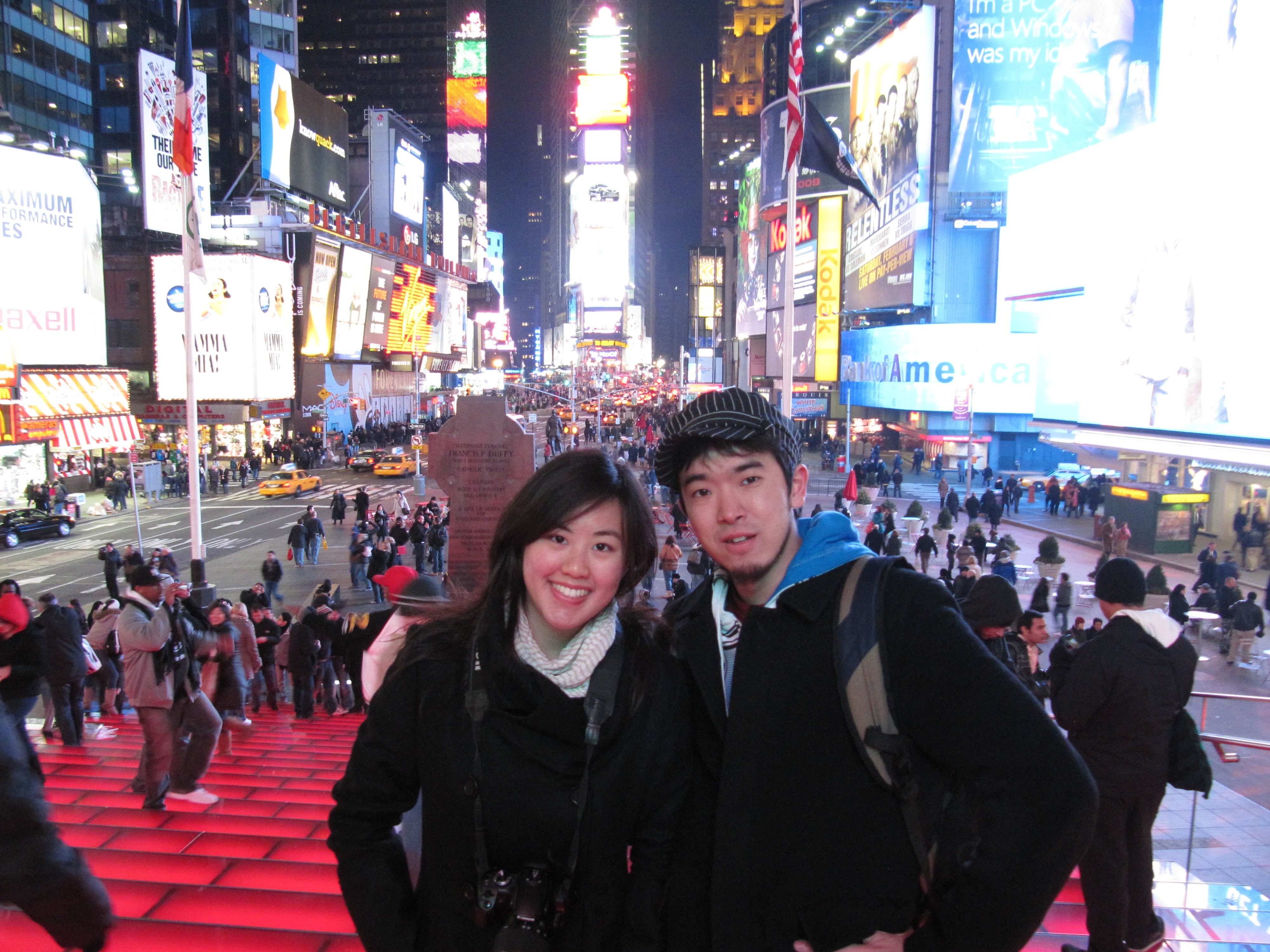
At Times Square, January 15th, 2010 with faithful travel companion @serenastyle

Okay, so that’s enough of my summary, I’ll post more details next.

Thoughts on American citizenship

I just got an email from my company’s Global Migration team about U.S. Naturalization Workshops they’re hosting. I laughed for a bit and then smiled at the fact that this is relevant in the company and then that something like this would be offered for free. It would be a 30 minute session, 1:1 with a naturalization attorney to discuss the family situation, and the process (there’s a LOT of process).

Then I realized that this actually applies to me too. For those who don’t already know, even though I’ve lived a total of 18 years (out of my 24) in the United States, I’m still technically a citizen of the Republic of Korea. Sure, I’ve been a visa holder, and now bear a Permanent Residency, but in some ways there’s always been some sort of invisible barrier, or mark that subtlely reminded me that I was still an outsider. Growing up, this wasn’t something that really seemed to matter, other than being a mental note and a BIG inconvenience when applying for colleges, jobs, etc. When I first came back to the U.S. in 2000, I as a J-2 dependent, under my dad’s J-1. J-visas, I believe, are for foreign contract workers, without the intent to immigrate; in other words, not allowed to apply for permanent residency. At some point, I shifted to R-2 under my mom, and had it until moving to PR status. Yes, what an honor; I am now a resident alien of this country, and have my fingerprints in some database in the Department of Homeland Security. Yay.

Not surprisingly, I’ve always felt that my relationship to the U.S. government and the country itself was a bit conditional; despite growing up taught that my story is one of many millions, and virtually every person with an immigrant story in their family history (yes white people, you fall into this category too–gasp), yet something seems to happen to those people bearing the U.S. Citizen title, and enjoy privilages not available to the millions of other non-citizens living in this land.

Let me say in advance, that I don’t quite use the terms “American” and “U.S. citizen” interchangably. I know U.S. citizens that haven’t spent more than a few weeks of their adult lives in this country, and certainly don’t relate to the culture, as well as non-citizens that are working for the political campaigns, pay dues to the NRA, and have kids in American public schools. Who’s the more “American” one of those two?

Most people don’t really think about citizenship this way–they’re either born into one country or the other, and they don’t bother doing anything else. If they choose to stay in the United States, they’re generally happy about it enough, and their citizenship status to care. Even activist Americans that seem to treat the term as if holding a little bit of shame don’t deny that they’re Americans. For most people, it’s really simple–it’s something associated with the country you happen to live in; it’s something you’re born with, and no more changable than the culture you live and breathe. Having spent 2/3rds of my life in this country (and probably 90% of my formative years), and yet still not being a citizen, I’ve always thought of the concept very archaic, and with regards to the process of changing citizenship, it’s filled with rules that I never really bought into logically. As a teacher, what do you teach a kid that’s learning about Thanksgiving in school, if there are non-citizens in the room? Do you call them out to recognize that they’re different, or that this history doesn’t apply to them, or teach that there isn’t anything different, and that many cultures come together to make this country? My second grade teacher (Mrs. Halversen, Willard Elementary; Evanston, IL–if you ever see this, you’re awesome!) chose the latter, and it seemed to make sense; for natural-born and naturalized Americans, as well as foreigners and hybrids like me.

Well that’s great when you’re growing up, or in college, grad school, med school. You’re paying money (or your parents are in the form of taxes) to get an education, and people will generally assume that you’re a contributing member of society. Growing up, many of my friends were in a simlar boat, and that made it very easy to discuss the challenges, and work through the ambiguous. Besides, our pride for Naperville North, the Fighting Illini, and Chicago was far more feverent than this abstract concept of national pride. Much of that changes if you choose to work, and take those skills/knowledge that you gained while in school to make money in the great U, S of A, like I’ve chosen to do. Sure much of the multi-culturalism is there, but now that taxes, elections, and societal impact are concerned, it seems to matter so much more what color your passport is. I believe I’m contributing to the larger world, but I’ve definitely been privilaged to have grown up, and to work and live where I do.

Do I consider myself American? Haha, that’s a tough question. Historically, I’ve said no, and understood that my status made me somewhat different. Do I consider myself Asian-American? Absolutely. The feelings, privilages, and difficulties as well as my story fits very closely. Is citizenship tied to it? It probably should, more than it does, but I feel my experience would have been the same even if I had been born as a citizen. If my parents I had moved to Chicago a year earlier, I would have been a natural-born American, and we wouldn’t be having this conversation. As for citizenthip, despite the fact that it should be the ultimate representation of your heart’s loyalty to a culture, usually, the reasons why someone is one or the other is completely arbitrary, and influenced far more by practical reasons than one’s loyalty to the words of Francis Scott Key.

And you know what… I think I’m okay with that. Kind of like software patents, it’s an archaic system that’s broken in so many ways, that it might as well be scrapped. But it provides some value, and in a noisy world where we need to label and generalize to live and make sense of things, it helps a great deal. It’s not a problem that many have to even think about, my parents certainly didn’t, and my kids probably won’t–but as a very small segment of the story, I feel a need to write about my experience. I’ll do that some day. In the mean time, I’ll check out this workshop =).

Thanks Global Migration team!

Who needs names when you have memes?

I had the most awesome fun discussions with some CouchSurfers last Friday. It was my first time hanging out with members of this massive community, and it was a great one. I swear, I think I’m developing a little bit of hippie-ness inside of me after living in Seattle for nearly a year. Meeting new people is so much fun, especially open-minded, accepting, less judgemental people that love expressing themselves, but also love listening just as much–sometimes I wonder why more of the world can’t be like this.

We spoke on all sorts of topic that somehow all seemed to point towards some common sense of spirit, be it a discussion on:

– American/Korean cultural imperialism across Asia
– A debate on linguistics and the relevance of the Sapir-Whorf hypothesis (which Zina claims has been disproven–whoooohooo!!!!)
– North Korea’s attempts to eliminate gov’t resistance by removing words that “fuel” oppositionm, and whether or not this is counter-productive since it creations social memes of generalized concepts
– The importance of language at communicating a movement of resistance to authority
– Whether or not Twitter’s “trending” topics are analogous to cultural memes outside of the web-context…
– Racism in Korea, Asia, and the *importance* of American imperialism to promote peace (i know Joyce would’ve loved this part of the discussion), and et cetera to infinity…) This could go on for so long about the awesome discussions we had, but from there, I gleaned a few important thoughts.

First, that I have this deep internal need to be social on an intellectual level. Sure, I have friends that I discuss politics, life, values, etc with, but not in a *long* time (at least since the debates on religion that I had with Nick/Jason) have I had that sense of making an epic scholarly journey through perspectives and life, but that was five years ago. I needed this discussion to spark my curiosity for now, and the future.

Second, (should I be starting a new paragraph???) I have a very strong sense of “sharing” what I believe and love with my friends, family, and the world. I knew this when I felt the joy of recommending a movie that moved me, or a story that somehow touched a part of my life, or even inviting a friend into a discussion that I passionately care about. That joy of sharing is so vital to my sense of contribution to the world, that if I didn’t have all these outlets to post Status Updates, Youtube / Article Links, Twitter updates, blog posts, I think I would be painting posters and hanging them off my apartment expressing the same. I had such happiness sharing ideas, listening to these peoples’ stories, that I knew I had to do it again. And I will.

Finally, I learned that in most places in my life, we highly-emphasize the importance of building relationships, building trust, and remembering names. We have this, “prove me your worth first, then we can be friends/collegues, etc…” attitude that is pervasely self-oriented, conceals personal agendas, and focuses on building “goodwill” i.e. the currency of soft-power. It might be necessary in social settings, but the CouchSurfing community blows that away completely. The hippiness that I loved was the implicit trust in people, that we can talk about personal details, share stories, without the concern of judgments or retributions because we all seemed to recognized that we were merely individuals, and while our common bond might be our language, there could have been any number of divergent lifestyles and viewpoints at that table. And somehow, it didn’t matter. I guess you kind of have to have this attitude, since people in this community come and go as fast as people you see on a bus. You might meet someone you could be best friends with, but their lives take them where they go, and that’s ok. Did I mention that after hours of passionate discussion that i hardly knew each others’ names, who they were, or where they came from? In the corporate world, asking someone’s name might have been an insult (“after this deep talk, you still don’t know my name?!”), but here, it wasn’t even necessary. As someone who can’t remember names for the life of me, I liked that :).

Anyway, the only point I wanted to make by this point is to be open, be sincere, accept those around you, and love thy neighbor. I remember reading once in a blog post a comment that some Brit had made, and it stuck with me as something to live by: “Live free and die free, fuck the powers that be, but respect your fellow man.”

Now there’s something I can live and die by.

Related Links:
–
http://www.couchsurfing.org/